
For more than a decade, supply chain leaders have been promised that artificial intelligence would finally fix planning. Yet for many organizations, planning remains slow, siloed, and opaque—especially as tariffs, demand volatility, and geopolitical shocks continue to expose the limits of traditional S&OP models.
According to Piet Buyck, the problem has never been a lack of algorithms. It has been a lack of shared understanding about why numbers change and how decisions should change with them.
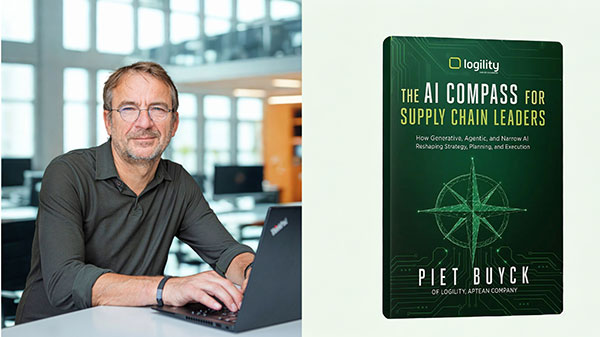
Buyck, senior vice president of innovation strategies at Logility, an Aptean company, has spent more than 15 years building AI-driven demand planning systems. In his new book, AI Compass for SC Leaders, he argues that the next evolution of planning is not about replacing humans with automation, but about creating explainable, collaborative intelligence where data, assumptions, and decisions are transparent across the organization. As generative and agentic AI mature, Buyck sees a fundamental shift underway: from aligning on numbers after the fact to aligning on decisions in real time.
Buyck joined Supply Chain Management Review to discuss his book, AI and more.
(Answers have been edited for length and clarity)
SCMR: What inspired you to write The AI Compass for Supply Chain Leaders, and why is now the right moment for this book?
BUYCK: I’ve been working on AI-based demand planning for 15 years. After attending countless conferences on supply chain management, I learned that even the biggest, most sophisticated organizations were still struggling with the complexity of supply chain planning.
There were many reasons for this. Their data was siloed. They misunderstood important information. Even internal politics prevented companies from getting this right. Of course, early supply chain planning was also limited just to internal data.
With my understanding of AI, I made a vow to find a way to replace the old S&OP planning approach with something more efficient. Initially, I thought AI would simply automate planning. Now I know that real collaboration only happens when decision information is transparent for everyone.
With those insights, I developed my first AI-driven demand planning system, which leveraged a language that translated external information into business impact. The key breakthrough was that this language could interact with large language models (LLMs). Then, in 2022, when ChatGPT entered the market, I had an aha moment: if I could create a planning environment that understands the “why” behind the numbers, I could make planning truly intelligent and collaborative.
That realization became the foundation for the new process, and ultimately, for The AI Compass for Supply Chain Leaders.
SCMR: The book talks about AI as more than just automation—it’s about creating a more connected, collaborative way to plan. How is this transforming the relationship between people, data, and decision-making?
BUYCK: The challenge in planning has always been understanding what lies behind a number, and how a change in that number requires a different action.
Until now, only humans could provide that context. But when information is passed on orally or in writing, it takes an enormous amount of discipline to prevent it from diverging as it moves through the organization.
With AI, this information can now be digitized. Numbers and insights become interchangeable and instantly available to everyone the moment change occurs. This creates a connected environment where large language models can summarize that information and prepare it for decision-making.
Since large language models enable interaction in natural language, everyone, regardless of their technical background, can contribute their insights directly into the planning process.
SCMR: Supply chains became headline news during the pandemic, and tariffs are again creating ripple effects across industries. How can AI help companies navigate disruptions like these and prevent the kinds of shortages and delays that impact everyday people?
BUYCK: You can look at supply chains as complex, living networks. Tariffs, in their most abstract form, as well as major events, effectively redefine some of the equations within that network.
With AI and connected data, it becomes possible to monitor where the system needs to adapt more quickly, communicate those changes more clearly and easily, and identify vulnerabilities much earlier.
When disruptions occur, the assumptions underlying your planning may suddenly become invalid or require revision. AI reduces decision latency, allowing organizations to react faster, make better-informed adjustments, and ultimately minimize the impact of disruptions on customers and everyday people.
SCMR: How does AI—particularly generative AI—make planning more collaborative and explainable across different departments?
BUYCK: Generative AI provides a natural, human-language interface for complex data. This allows everyone, regardless of their technical background, to interact with the planning process and contribute their insights.
Planning is about assuming a certain combination of events will result in a specific outcome. Each functional silo contributes to that number through assumptions.
By making those events (and their impact on the numbers) transparent and understandable, organizations can now discuss why the numbers are what they are, rather than trying to align on the numbers themselves. This shift enables collaboration and makes the planning process explainable and inclusive.
SCMR: Some fear AI will replace jobs. How do you see it reshaping the roles of supply chain professionals instead?
BUYCK: Agentic AI will be able to execute tasks much like humans do, but it cannot assume responsibility.
Today, the planning function often spends 90% of its time mechanically assembling information to fit budget numbers. With AI, that time can be redirected toward finding solutions, discussing the best strategies, and making better-informed decisions with the numbers already at hand.
Will there be fewer roles focused on data assembly? Yes. But there will be more roles centered on strategy, scenario planning, and decision-making.
SCMR: Looking ahead five years, how will AI redefine what it means to lead in supply chain?
BUYCK: Control will move closer to those on the ground, as they will have all the data needed to make informed decisions in real time.
Where today most organizations still rely on broad, standardized solutions, AI will enable systems to adapt dynamically to the detailed actions and context of each enterprise.
The focus will shift from merely executing a fixed plan to managing a data-driven engine that continuously learns, adapts, and provides solutions for even the smallest environmental changes.
I believe this will allow organizations to perform at their best by enabling higher-quality decisions, offering consumers more choices, reducing waste, and eliminating needless work.
In short, AI will redefine leadership from controlling processes to empowering intelligence throughout the entire supply chain.
SC
MR

More S&OP;
What's Related in S&OP;

 Explore
Topics
Procurement & Sourcing News
- When component verification becomes operational
- Caught between a rock and a hard place: Mapping your supply chain
- What options do you really have? Shaping the supply chain resilience funnel
- Nexus suppliers: Hidden anchors of resilience in decentralized supply chains
- Lead time economics: What semiconductor supply chains reveal about strategic planning
- Risk sharing is the new advantage in capital project delivery
- More Procurement & Sourcing
Latest Procurement & Sourcing Resources
Subscribe

Supply Chain Management Review delivers the best industry content.

Editors’ Picks



